
What an Action Potential Is
The spike that makes neural communication possible

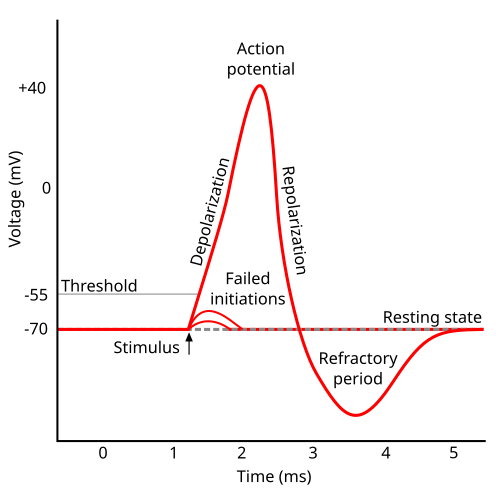
An action potential is a rapid, all-or-nothing electrical spike caused by the movement of ions across a neuron’s membrane that allows signals to travel long distances without weakening.
The term “action potential” shows up constantly in neuroscience, often described as how neurons “fire.” But that phrasing can feel vague. What actually happens during that moment? Why is it called a spike? And how does something electrical move through a biological cell?
The confusion often arises from imagining neural signals as continuous electrical currents, like current through a wire. That intuition suggests signals could vary smoothly in strength as they travel.
That’s not how neurons work.
At rest, a neuron maintains a voltage difference across its membrane. The inside of the cell is more negative than the outside, largely because of how ions (especially sodium and potassium) are distributed. This difference is actively maintained by ion pumps and channels.
When a neuron receives input, its voltage shifts slightly. Most of these changes are small and fade quickly. But if enough input arrives together and pushes the membrane past a critical threshold, the system flips into a different mode.
At that point, an action potential begins.
Voltage-gated sodium channels open rapidly, allowing sodium ions to rush into the cell. This causes the membrane voltage to rise sharply; this is the upward spike. Almost immediately after, sodium channels inactivate and voltage-gated potassium channels open, allowing potassium ions to flow out. This brings the voltage back down toward its resting level.
This sequence happens in milliseconds, and it propagates along the axon. As one segment of the membrane depolarizes, it triggers the next segment to do the same. Because the process regenerates at each step, the signal does not weaken as it travels.
Crucially, this event is all-or-nothing. If the threshold is reached, the full spike occurs. If not, nothing happens. There are no partial action potentials.
We know this in detail from classic electrophysiology experiments, especially work on the squid giant axon, where researchers were able to measure voltage changes and ion movement directly. Modern techniques like patch-clamp recording have confirmed and refined this understanding at the level of individual ion channels.
A useful way to think about an action potential is as a domino chain. Tipping one domino doesn’t push the entire chain forward directly; it triggers each next domino to fall in sequence. The signal is regenerated at every step, which is why it stays strong over distance.
This explains why neural signals can travel from the brain to distant parts of the body without fading. It explains why signal strength is encoded not in the size of the spike, but in how frequently spikes occur. And it explains why timing (when spikes happen) can carry information.
It also clarifies what an action potential is not. It is not a continuous wave of electricity. It is not variable in size. And it is not the whole story of neural communication: once the spike reaches the end of the neuron, the signal becomes chemical at the synapse.
Understanding action potentials matters because they are the foundation of all neural signaling. Disruptions in this process are involved in conditions like epilepsy, where excessive firing occurs, and in certain channelopathies, where ion channel function is altered. Many medications, including anesthetics and anticonvulsants, work by modifying how action potentials are generated or propagated.
One open question remains: how precise patterns of action potentials across large networks encode complex information like perception, thought, and decision-making. We understand the spike itself well, but how billions of them combine into cognition is still being worked out.
An action potential is simple in isolation. But everything the brain does depends on it.
Sources
Hodgkin, A. L., & Huxley, A. F. (1952). A quantitative description of membrane current and its application to conduction and excitation in nerve. Journal of Physiology.
Kandel, E. R., et al. (2013). Principles of Neural Science.
Bean, B. P. (2007). The action potential in mammalian central neurons. Nature Reviews Neuroscience.