
What the hippocampus actually does (and what it doesn’t)
What the hippocampus does during learning, and what happens afterward

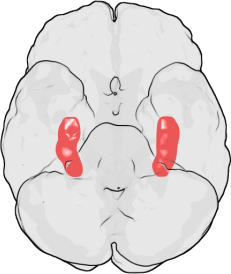
The hippocampus helps form and organize new memories by linking experiences across space and time, but it does not permanently store memories.
The hippocampus is one of the most frequently mentioned brain structures, yet it’s also one of the most misunderstood. It’s often described using metaphors that feel intuitive—like a memory hard drive or storage center—but those metaphors quietly distort what the hippocampus actually does.
The most common idea is that memories live inside the hippocampus. Under this view, damaging the hippocampus should erase a person’s memories wholesale, past and present. That’s not what happens.
The hippocampus sits in the medial temporal lobe and plays a central role in forming episodic memories—memories of events that happened at a specific place and time. When you experience something new, different features of that experience are processed in different parts of the brain: visual details, sounds, emotions, and spatial layout. The hippocampus helps bind those distributed pieces into a single, coherent episode.
Crucially, the hippocampus is not the final resting place of that memory. Over time, many memories become less dependent on the hippocampus as they are stabilized and distributed across cortical networks. This process—often called systems-level consolidation—means the hippocampus is most important early on, when memories are new and fragile.
Much of this understanding comes from lesion studies. Patients with hippocampal damage, most famously the patient known as H.M., were unable to form new episodic memories after injury. Despite this, many of their older memories remained largely intact. This pattern shows up again and again: damage the hippocampus, and the ability to create new memories is impaired, while long-established memories are often spared.
Animal studies and human brain imaging reinforce this picture. The hippocampus shows strong activity during learning and early recall, while older, well-rehearsed memories rely more heavily on widespread cortical regions.
A helpful way to remember this is to think of the hippocampus as an index, not a hard drive. An index doesn’t contain the information itself—it tells you where to find it. The hippocampus helps point to and assemble the components of a memory, especially when that memory is new.
This framing explains several observations. It explains why hippocampal damage leads to anterograde amnesia, the inability to form new memories. It helps explain why navigating new environments, imagining future events, and recalling recent experiences all rely heavily on the hippocampus. It also explains why memory problems often appear early in disorders that affect this region.
What this does not mean is that the hippocampus stores memories forever, that all memories depend on it equally, or that memory can be localized to a single brain structure. Memory is distributed, dynamic, and network-based.
Understanding what the hippocampus actually does matters clinically and developmentally. Conditions like Alzheimer’s disease, temporal lobe epilepsy, and traumatic brain injury often involve early hippocampal dysfunction. Developmentally, the hippocampus continues to mature through childhood, which helps explain why early-life memories are often incomplete or absent.
One open question remains unresolved: how exactly do memories transition from being hippocampus-dependent to hippocampus-independent over time—and are all memories eventually freed from hippocampal involvement, or only some?
Neuroscience is still working toward a complete answer.
Based on evidence from classic lesion studies, animal research, and human neuroimaging on memory consolidation.